
Compare the Main Stevens County Property Values
The Stevens County Appraiser discovers, lists, and values all property for the tax roll. That annual work draws on ownership, location, use, sales, building measurements, construction cost, and rental income. Identify the label before anything else. Then trace the number to its source. Knowing whether a figure came from an appraisal, the tax roll, or a recorded deed keeps the comparison honest.
| Value type | Meaning | Record source |
|---|---|---|
| Actual or market value | County estimate as of the valuation date, with agricultural land treated by use and income | Appraiser record and value notice |
| Assessed value | Actual value multiplied by the constitutional class ratio | Appraiser and certified tax roll |
| Sale consideration | A transaction clue that may appear with a deed; it is not automatically open-market value | Recorded instrument or verified parcel sale field |
| Land and improvements | Separate components that may combine into total actual value | Live parcel detail, if the fields are exposed |
Kansas applies a class percentage, so assessed value usually sits below actual value. A deed amount carries its own traps. It may reflect a non-market transfer, a partial interest, a family conveyance, or a quitclaim. Compare labels and dates, not just dollars.
Stevens County Values Property Each January 1
Residential actual value is market value as of January 1. The Stevens County Appraiser says the review considers comparable residential sales from the prior three years along with economic conditions. For non-residential property, the office may use comparable sales, cost less depreciation, and income methods.
A value therefore belongs to a fixed annual date. A later improvement, sale, or market change does not turn the January figure into a live asking-price estimate. County Appraiser Angela Eichman's office at 200 E 6th in Hugoton is open 9 a.m. to 5 p.m. and can be reached at 620-544-2993 when a value label or year is unclear.
The county page shown below explains the local valuation method and links the current assessment materials.
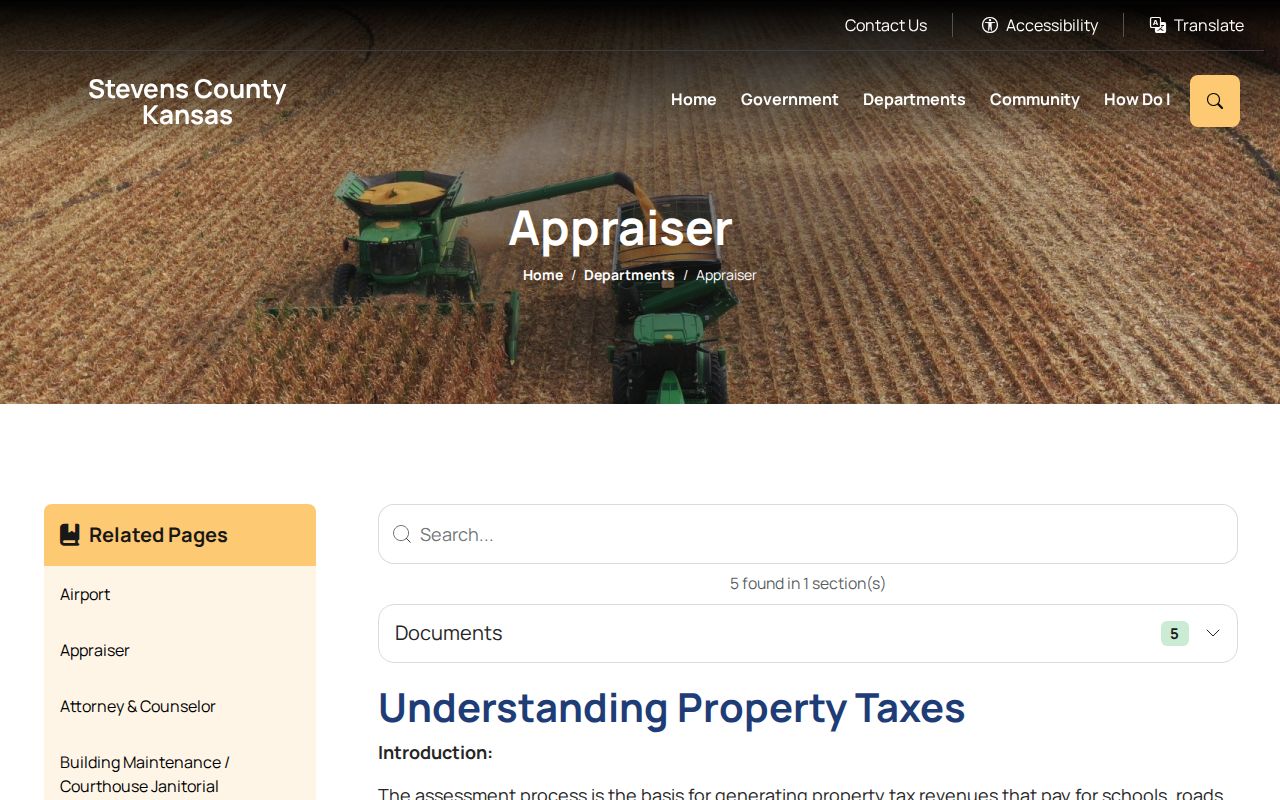
The official page explains the method, not one parcel's value.
Kansas Ratios Turn Actual Value into Assessed Value
Residential property carries an 11.5 percent ratio in 2025. Commercial property is listed at 25 percent. Agricultural land is assessed at 30 percent using use and income value, agricultural improvements at 25 percent, vacant lots at 12 percent, and nonprofit property at 12 percent. Other property sits at 30 percent. The state ratio sheet separately lists public utility property at 33 percent.
| Property class | 2025 ratio | Valuation point |
|---|---|---|
| Residential | 11.5% | Market-based actual value |
| Commercial | 25% | Applicable actual value method |
| Agricultural land | 30% | Use and income value |
| Agricultural improvements | 25% | Improvement value |
| Vacant lots | 12% | Actual value |
Confirm the parcel's classification before applying any percentage. A classification error shifts the assessed amount even when actual value stays the same.
Note: Agricultural land uses a use-and-income basis, so comparing it directly with an open-market residential figure can mislead.
Locate a Stevens County Assessed Value
Stevens County links to ORKA. That Kansas service combines property records with mapping. A disclaimer appears before the ArcGIS experience opens. Parcel-card value labels and history fields show up only in live results, so read the labels actually displayed rather than assuming a generic parcel format.
- Open the Stevens County ORKA entry, accept the official notice, and locate the parcel by address or map.
- Copy the parcel number, property class, valuation year, and every displayed value label exactly.
- Check whether land, improvements, total actual value, and assessed value appear separately; do not assume missing fields exist.
- Use the recorded deed only as a dated transaction comparison, then ask the Appraiser about unexplained differences.
- Actual value
- The county's value before the Kansas class ratio is applied.
- Assessed value
- The class-adjusted amount used in the tax calculation.
- Assessment ratio
- The percentage assigned to a constitutional property class.
- Reassessment
- The annual process of reviewing the value as of January 1.
Read Stevens County Value Dates in Order
The annual calendar explains why two official records show different stages. January 1 is the valuation date. By March 1, a change-of-valuation notice goes out. It shows the property description plus prior and current actual values. The county certifies values to the Clerk on June 1. Tax bills follow in November.
Keep that chronology nearby. A March notice and a later tax record can describe the same annual valuation at different administrative points in Stevens County. Bill payments, exemptions, and appeals are covered in the Stevens County property tax records guide.
A Recorded Sale Is Only a Stevens County Value Clue
The Register of Deeds records Stevens County real-estate transactions. The county publishes no online deed index. A deed may state consideration. That amount is not automatically the market value of the whole property. A quitclaim can transfer an interest without any ordinary sale. A trust, estate, or joint-tenancy deed may simply record a change in legal ownership.
Confirm the instrument date first. Check the parties, deed type, and legal description too. Only then compare the figure against a valuation. The public ORKA view shows no sale-price field, sale-validity code, or comparable-sales display. Wait for a live parcel result before crediting those features to the local portal.
Land and Improvements May Carry Separate Values
Measurements, construction, cost, use, and sales may all appear in the county's appraisal data. That detail supports separate land and improvement analysis. Land and buildings behave differently. Where the fields sit on a parcel card varies. When a live result exposes them, record land actual value, improvement actual value, total actual value, assessed value, class, and year as distinct fields.
The split helps when a building was added, removed, damaged, or remodeled. It also clarifies vacant land set against an improved parcel. It cannot isolate every feature's effect. Some figures need deeper records. Ask the Appraiser for the record detail or property-description report behind a number the screen cannot explain.
Mill Levies Convert Assessment into Tax, Not Market Worth
The Appraiser's office teaches the math plainly. Take actual value, apply the assessment rate, then multiply by the mill levy. The office's example uses a $6,900 assessed value and 125 mills, written as .125. The result is $862.50. That figure is only a teaching example. It does not represent a complete levy for every Stevens County parcel. Levies vary by taxing district. So two parcels with similar actual values can carry different bills. That gap says nothing about which one holds the higher market value. Keep value questions separate from the Treasurer's payment and delinquency records.
Use Current Stevens County Assessment Materials
The Appraiser's page collects several useful documents. These include a Market Study Analysis for Stevens County 2025 Assessment. There are also equalization appeal guides, payment-under-protest guides, and an exemption application. Together they set the working year and the county's method. They do not forecast prices for a street. Values and guidance shift with each new cycle. Record the year shown on the source. Refresh any comparison before you lean on it. When a parcel class, ratio, or value changes, save the earlier notice alongside the current record. That way the difference can be explained rather than guessed.
Know the Limits of a Stevens County Property Value
The assessor's value comes from mass appraisal. The system serves public valuation and taxation. It is not a parcel-specific private appraisal, a title opinion, or a promise of what a buyer will pay. The annual date can also leave the record older than a recent change in the property or market.
Value versus price. A Stevens County assessed value serves the tax system and does not state what the property would sell for. Use a licensed appraisal for a current market opinion.
Timestamp Stevens County Values
Note the January 1 value date. Record the parcel class, ratio, and source too. A later sale, exemption, or improvement may belong to another reporting period, so keeping dates visible stops an assessed value from being passed off as a current sale estimate.