
Stevens County Tax Record Fields
Every field has a source. Stevens County tax records blend Appraiser values, Clerk-certified levies, and Treasurer billing, each with its own date. The bill is no market appraisal.
| Field | What it shows | Where |
|---|---|---|
| Actual value | Appraiser's estimate as of January 1 | Appraiser and ORKA |
| Assessed value | Taxable value after class ratio | Appraiser |
| Mill levy | Rate applied to assessed value | Clerk and tax bill |
| Tax status | Bill, payment, or delinquency | Treasurer |
| Exemption | Approved exempt treatment | Appraiser |
Pair the assessment year with the tax year. A payment result should also be checked for installments, interest, and any receipt references.
Look Up a Stevens Tax Bill
The official Treasurer application is the online route. The page presents an application shell, so its exact search fields and result labels are not documented in advance. Trust the live labels, not assumptions about owner, address, or parcel inputs.
- Find the parcel number through ORKA or the Appraiser.
- Open the matching Treasurer account.
- Confirm tax year, taxpayer, situs, and levy.
- Read installments, paid dates, and any balance.
- Ask the Treasurer about unclear or older entries.
For direct help, the Treasurer is at 200 E 6th in Hugoton, 620-544-2542, and publishes office hours of 9 a.m. to 5 p.m.
View the official tax application interface.
The capture documents the county-linked application but does not support invented field names.
Actual and Assessed Values
The Appraiser sets residential actual value at market value as of January 1, informed by comparable sales from the prior three years. Assessed value is the portion used in the tax formula. It equals actual value multiplied by the class assessment ratio. The mill levy is then applied to assessed value.
- Actual value
- The county's estimated value under Kansas appraisal rules.
- Assessed value
- The taxable share after the class ratio.
- Mill levy
- The tax rate expressed in mills.
- Tax lien
- A claim arising from unpaid property tax.
The county's teaching example multiplies a 6,900 dollar assessed value by 125 mills. The result is 862.50 dollars. That is an illustration, not a parcel quote or a full Stevens County levy.
Stevens County Assessment Ratios
For 2025, residential property is listed at 11.5 percent. Commercial property takes 25 percent, vacant lots 12 percent, and nonprofit property 12 percent. Agricultural land is set at 30 percent based on use and income value, with agricultural improvements at 25 percent and other classes at 30 percent. State material lists public utility property at 33 percent.
| Class | 2025 ratio | Key point |
|---|---|---|
| Residential | 11.5% | Actual value is market based |
| Commercial | 25% | Sales, cost, and income approaches may apply |
| Agricultural land | 30% | Use and income value applies |
| Vacant lot | 12% | Class controls taxable share |
Confirm the class on the current assessment before applying a ratio.
The Stevens Appraisal Calendar
The County Appraiser publishes a clear cycle. Value is set as of January 1. A change-of-valuation notice is due on or before March 1 and shows the property description plus prior and current actual values. An appeal must be filed within 30 days of mailing.
Hearings conclude by May 15, decisions are due May 20, values go to the Clerk by June 1, and a hearing officer decision is due July 1. Tax bills are issued in November. Personal-property filing has a separate May schedule.
Review the Appraiser's current value and appeal material.
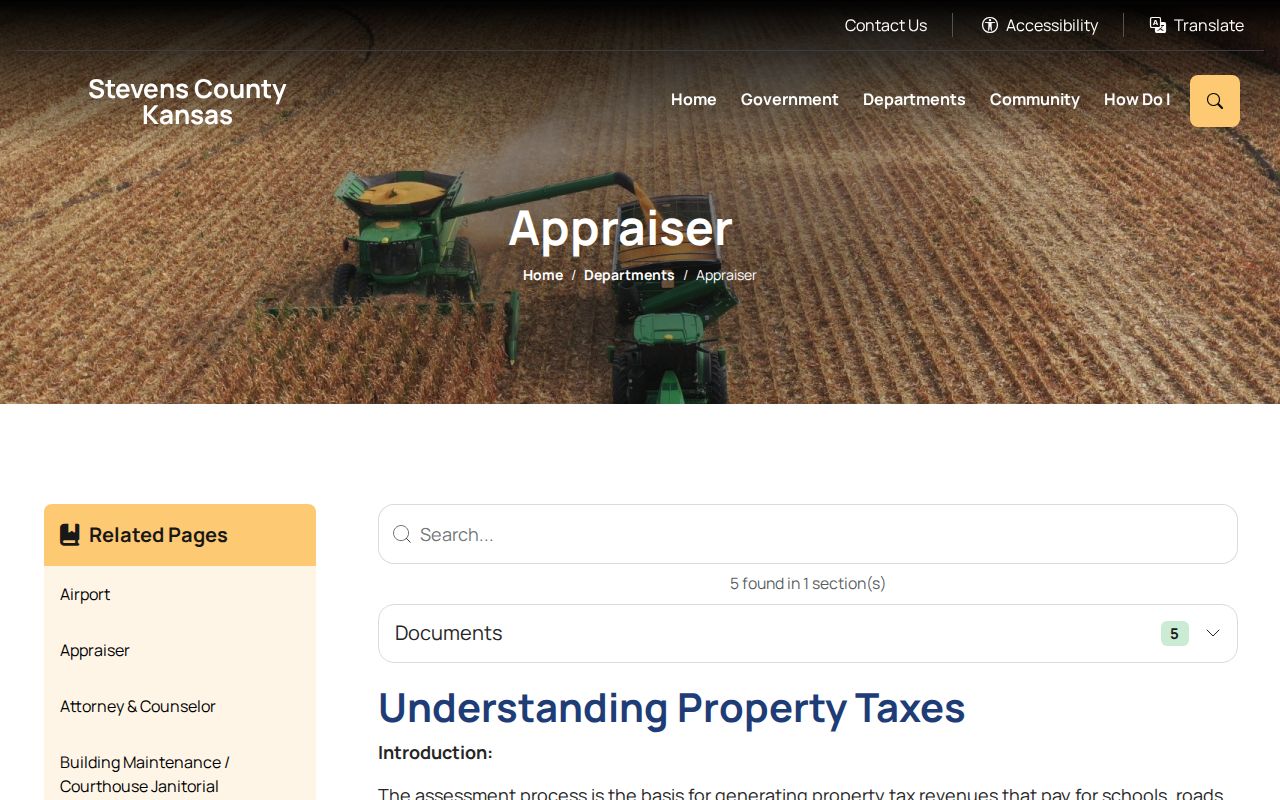
The Appraiser's office page posts annual timing, so check it for any later cycle dates.
Appeal a Stevens County Value
Read the notice date first. The 30-day appeal period runs from the mailing date. Compare the property description, class, land and improvement facts, and prior value before filing. Useful evidence includes corrected building measurements, photographs, repair facts, comparable sales, or proof of a wrong use classification.
Equalization appeals and payment-under-protest are different procedures. The county links separate brochures for each, so pick the route that fits your stage of the tax cycle and keep dated copies of the notice, evidence, and filing.
Appeal deadline. File within 30 days of the valuation notice. Waiting for the November bill may require the separate payment-under-protest route.
Stevens County Exemption Records
The Appraiser describes exemptions for churches, farmers' grain storage, and taxing entities. It also links a county application. Eligibility comes from the form and law. A portal label alone proves nothing. So ask whether the file shows approval, the effective year, property class, and the part of the tract covered.
The county forms index lives at Stevens County forms. Some relief programs are not exemptions. Before you file, confirm which office actually administers the benefit you are requesting.
Delinquent Stevens Property Tax
A public notice dated August 7, 2025 reported unpaid 2024 real-estate taxes as of August 1. It listed a 16 dollar advertising fee per parcel and 9 percent interest. Those dated figures explain that publication only and should not be treated as permanent charges.
The county states that unpaid real-estate tax enters the delinquent roll after the statutory September threshold. Under K.S.A. 79-2401a, the oldest delinquent year is paid first. Property three years delinquent can face foreclosure and public sale. Verify the current balance with the Treasurer and any filed action in court.
Clerk and Treasurer Tax Roles
County Clerk Amy Jo Tharp combines valuations across tax districts, certifies values, and prepares the real, personal, and state-assessed roll. She also processes added and abated taxes and records levies. Treasurer Jayme Rich collects real, personal, business, and entity taxes. Her office then distributes the revenue. Both offices sit at 200 E 6th in Hugoton. Call the Clerk at 620-544-2541 for levy breakdowns, roll certification, or added and abated tax context, and the Treasurer at 620-544-2542 for bills, payments, delinquency, or receipts.
Tax Rolls Do Not Prove Title
Stevens County's tax roll names a taxpayer, not necessarily the current owner. The Appraiser updates ownership within assessment data, but no fixed deed-to-roll refresh schedule exists. A deed recorded after January 1 can be newer. It can beat the roll's owner of record. Treat the roll as a value and taxpayer tool. Then confirm any transfer in the latest recorded deed.
A related trap exists. The estimated valuation in a revenue-neutral-rate notice describes a whole city or taxing unit. It is not a parcel's sale price or market value. Keep district fiscal figures separate from the property record you are actually studying.
Assessment disputes work best when they stick to facts the Appraiser can test. Verify acreage, class, use, building size, age, quality, and condition. Check the sales used as comparisons too. A neighboring sale is not automatically comparable. Its use, tract size, improvements, or sale conditions may differ. Agricultural land follows use and income valuation rules. A nearby residential price proves nothing about its taxable value. Ask which data supported the notice, and submit corrections before the deadline.
Multi-year tax research deserves care. Values, ratios, levies, exemptions, payments, and interest can each move on their own. Preserve every year's snapshot. Export or print the live result when the application allows it. Keep receipts labeled with the tax year and parcel number. If a payment seems missing, do not assume delinquency. Give the Treasurer its date, amount, method, and confirmation. Historical roll or levy questions belong with the Clerk.